Connecting AI, strategy & leadership
People adopt what they understand. We pair AI acceleration with human-centred strategy to turn change into measurable outcomes.
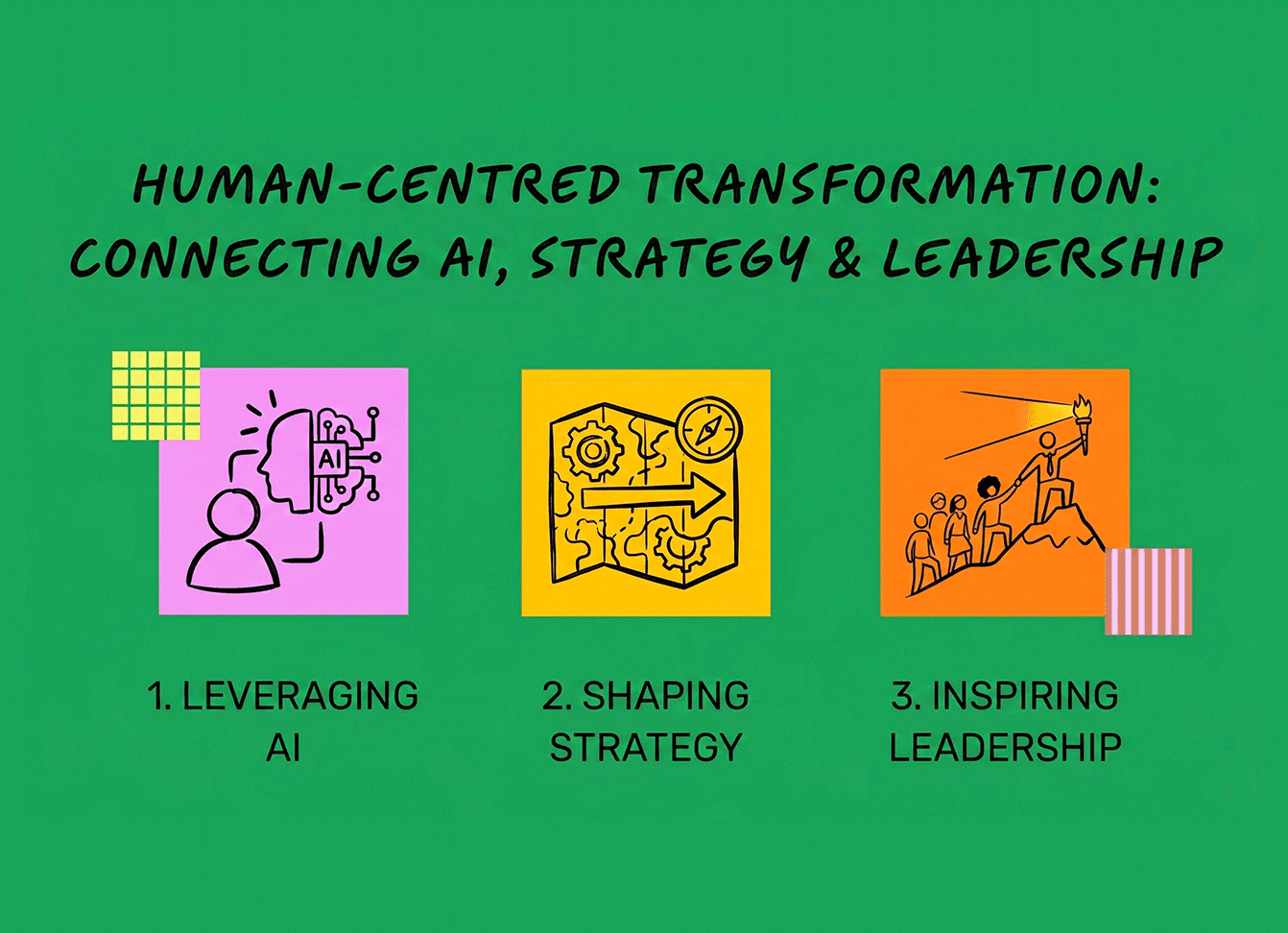
Every leader we meet wants transformation to happen faster, with trust intact. AI in the design process is what makes that balance possible.
Transformation isn't about the technology you implement. It's about people, customers, staff and stakeholders, and how you connect strategy to delivery so change actually lands.
AI accelerates the work, not the judgement
Building a service blueprint, synthesising research, crafting personas. This work used to take days or weeks. With the right models and frameworks in place, the same outputs can be generated in hours. Still grounded in data, still validated with stakeholders.
AI gives us speed, repeatability and the ability to scale. Empathy, curiosity and trust still do the work that matters. We use AI to generate persona inputs from real customer data (often validated against tools like Power BI), to surface research patterns at speed, and to draft narratives that experienced practitioners then sharpen.
The question isn't what AI replaces. It's what AI frees us to focus on.
A repeatable framework
No two transformations are the same, but the structure we use is consistent.
Strategy. Define the vision, outcomes and organisational shifts required.
Target-state blueprint. Research, actively listen, map journeys, highlight touchpoints, enable technology for staff and customers alike.
Requirements. Bridge design intent into deliverables technical teams can act on.
Delivery. Where the work shows up in production.
AI accelerates each phase. The result comes from the continuity (strategy through delivery), not from speeding up any single step.
People still decide outcomes
Even with AI in the mix, transformation is people work. Without trust and alignment, nothing moves. Strong relationships, shared understanding and clear ownership are what turn strategy into adoption.
AI helps by freeing time from manual synthesis, leaving more for the conversations and workshops where transformation either lands or stalls.
What this means for executive teams
Across financial services, government, retail and utilities, the pattern is the same. Leaders want speed without sacrificing trust.
For CFOs: faster time-to-value and clearer ROI.
For CMOs: the ability to move with the market.
For CX leaders: stronger customer loyalty through quicker improvements.
A recent example. Synthesising 20 customer interviews dropped from a week to a single day. The week we got back went into strategy and stakeholder engagement, not deck production.
Where this is heading
AI doesn't replace designers, strategists or leaders. It changes how we work, sharpening insights, speeding execution, and freeing us to focus on trust, decisions and outcomes.
The split widening in 2026 isn't between organisations that use AI and those that don't. It's between those who use it well and those who don't. The work we do, often alongside alliance partners like Microsoft, Databricks and Google, is built for the first group.
Category
News
Written by

Omnia Collective