Inside the Databricks Data + AI World Tour 2026 Sydney stop
Our team is at Databricks' Data + AI World Tour Sydney 2026. Read about insights from the day.
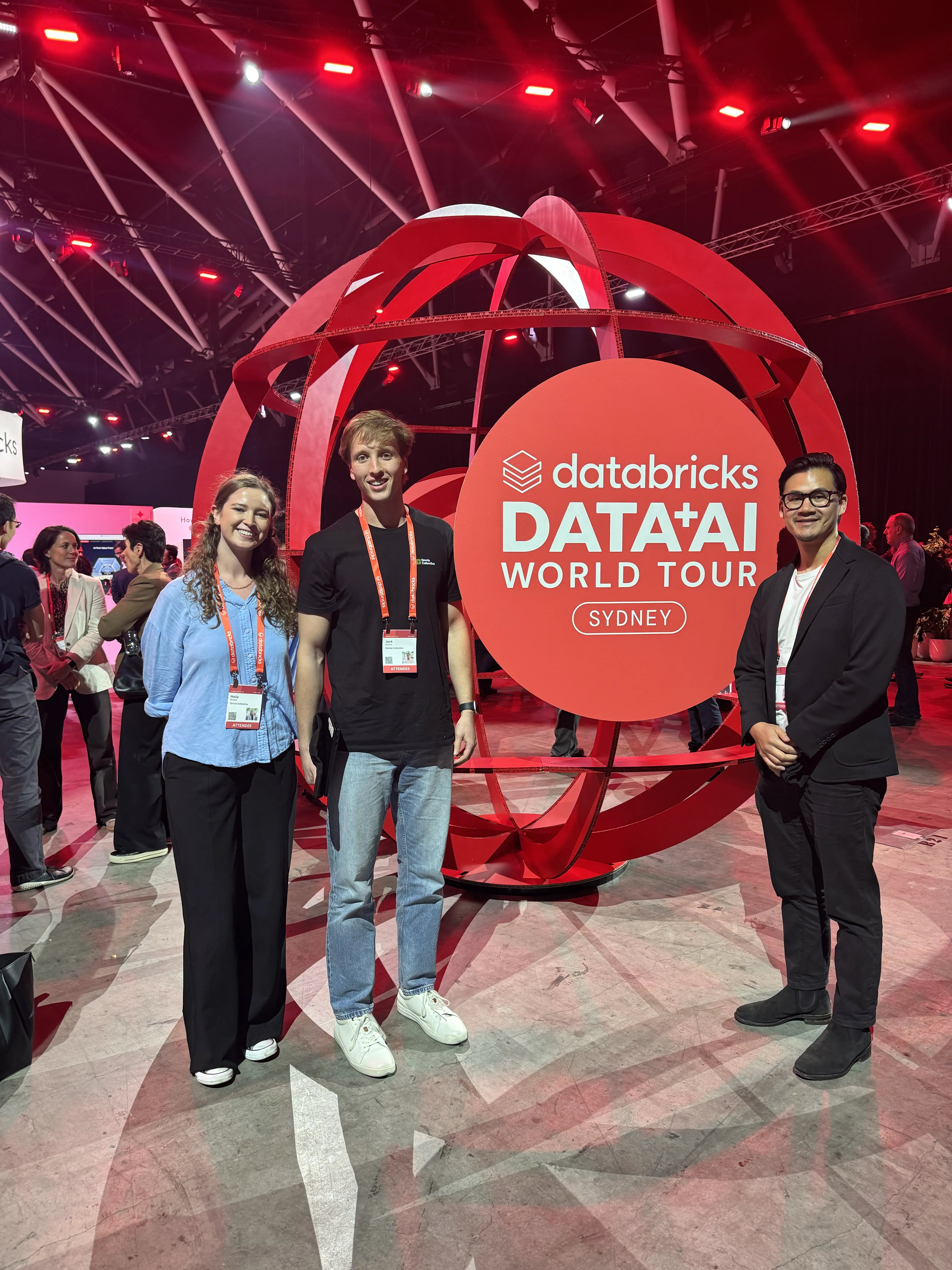
The most interesting thing at Databricks' Data + AI World Tour in Sydney wasn't a feature announcement. It was how difficult Databricks is becoming to describe.
Is it a data platform? An analytics platform? An AI platform? A database?
Increasingly, the answer is all of them.
Our team attended the Sydney stop of Databricks' Data + AI World Tour, and while there was plenty of discussion about individual releases, the bigger story for us was what happens when all of those releases are viewed together.
The boundaries between the data platform, AI platform and application layer are starting to blur.
And that could have a much bigger impact on enterprise architecture than any single AI announcement.
We've spent years adding more to the stack
For the last decade, enterprise data architecture has become increasingly specialised.
A transactional database runs operational systems. Data moves into a warehouse or lakehouse. BI tools sit on top. Machine learning has its own tooling. More recently, organisations have added LLMs, vector databases, AI gateways and agent frameworks into the mix.
Every new capability has tended to mean another piece of technology.
AI initially followed the same pattern: take the existing stack and add an AI layer.
What we saw in Sydney suggests the next phase could look quite different.
Instead of adding more, organisations may start asking what they can remove.
Databricks is expanding in both directions
Look at several of the announcements together.
Lakebase brings transactional workloads closer to the lakehouse, challenging the traditional separation between operational and analytical data.
Agent Bricks moves Databricks further into building and operating AI agents, with evaluation treated as part of the development process rather than something added at the end.
Genie takes the platform closer to the business user, allowing people to interact with enterprise data through natural language.
At the same time, Unity Catalog continues to expand beyond traditional data governance into metrics, semantics, identity and the context AI systems need to interpret enterprise data properly.
Individually, they're product announcements.
Together, they point towards something more significant: the data platform is becoming an AI platform, and the AI platform is starting to become an application platform.
That changes the architecture question
For CIOs and CDOs, the question isn't simply whether these capabilities are useful.
It's what they make unnecessary.
If your core data platform can increasingly store and process data, govern it, define business metrics, support machine learning, power AI agents and serve operational workloads, do you still need the same number of platforms surrounding it?
In some organisations, the answer will absolutely be yes.
Specialised platforms exist for good reasons. Moving everything onto one technology can create concentration risk, increase vendor dependency and make cost management even more important.
But maintaining complexity has a cost too.
Every additional platform creates another integration, another set of skills, another security boundary and another thing somebody has to operate.
So we wouldn't come away from the World Tour saying: put everything on Databricks.
We'd come away asking: if you were designing your data and AI architecture today, knowing what these platforms can now do, would you build the same stack you have now?
For many organisations, we suspect the answer is no.
AI architecture shouldn't just be about adding AI
This is the part we think gets missed in a lot of enterprise AI conversations.
There's enormous attention on finding AI use cases, running pilots and selecting models.
There's much less attention on whether the underlying technology estate should change as a result.
But if AI platforms continue converging with data and application platforms, one of the biggest opportunities may not be a new AI use case at all.
It may be simplifying the architecture underneath them.
That doesn't mean ripping out systems because a keynote says you can. It means looking at upcoming investment decisions differently.
Before renewing another platform, adding another AI tool or introducing another integration layer, ask whether the capability now exists somewhere you're already invested.
And, importantly, whether consolidating it actually makes commercial sense.
Our takeaway from Sydney
The individual announcements at Databricks' Sydney World Tour were interesting.
The direction they point in together was more interesting.
The next phase of enterprise AI won't just be about what models and agents can do. It will also reshape the platforms organisations build around them.
For technology leaders, that creates an opportunity to do something we don't talk about enough in AI:
Simplify
The Omnia Collective is a certified Databricks partner, with certified team members working across data engineering, lakehouse architecture, analytics, machine learning and AI.
Our job isn't to find more things to put on Databricks. It's to help clients work out where the platform makes sense, where it doesn't, and what their architecture should look like as data and AI continue to converge.
If you're reconsidering your data and AI architecture, or trying to work out what the changing Databricks platform means for your roadmap, get in touch.
Category
News
Written by

Molly Bowes
Data Consultant